One Wash Can Save a Life Campaign
Water, Sanitation and Hygiene (WASH) are essential for life, health, dignity, empowerment and prosperity, a fundamental human right to every child and adult. In Ugandan context, poor sanitation and hygiene, as well as unequal access to safe drinking water, have made thousands of children and adults vulnerable to sickness and risks of death. Education and communication strategies under WASH about behaviour change have been explored to disseminate information to targeted audiences about issues of handwashing, Safe drinking water and Sanitation among communities.
Much as various communication and creative strategies about behaviour change on issues of handwashing, have been explored by UNICEF (2022) and Uganda, government, adherence to handwashing in urban areas in Uganda remains a very big challenge due to lack of consistent information flow, attitude about handwashing, the media used and its reach. The study therefore, explores how handwash messages and guidelines can be enhanced through use of 3D animation for improved interactivity with the communities.
Committed to
Responsible Investment
Use this space to promote the business, its products or its services. Help people become familiar with the business and its offerings, creating a sense of connection and trust. Focus on what makes the business unique and how users can benefit from choosing it.

Play Video
The
Concept
The campaign reimagines “Power is in Your Hands” into a 3D cinematic story where germs are portrayed as red villains and soap as a radiant hero, symbolizing the shift from fear to empowerment.

Storyline Narrative
A mother unknowingly spreads germs to her child until soap intervenes as a saviour, cleansing her hands and restoring safety, concluding with the hopeful message, “The power is in your hands.”
Application of 3D Animation
Through realistic 3D rendering, lighting, and CGI effects, the campaign visualizes invisible germs and soap’s power dynamically while resolving consent and cultural relevance challenges.
Campaign Overview and Goal
It promotes consistent handwashing with soap by transforming traditional hygiene messages into an emotionally empowering and ethically safe 3D narrative that targets caregivers and children.
Rationale and Media Adaptability
By merging emotional storytelling with modern technology, the campaign creates a unified, adaptable framework for platforms like TikTok, TV, and community screenings, proving that one wash can truly save a life.

Studio Guiding Questions

How have messages, images, and media been used in execution of existing handwash campaigns?

This question led to a critical analysis of existing campaigns such as “Power is in Your Hands” identifying its strengths (clarity, emotional appeal) and weaknesses (limited interactivity, over-reliance on fear, ethical concerns around identity exposure).
How can 3D animation technique be used to augment handwash messages and guidelines?

This prompted the exploration of 3D animation as a methodological innovation, capable of enhancing message delivery through symbolic storytelling, emotional balance, and interactive design suitable for both broadcast and digital platforms.
Thematization and Design Thinking Process
The campaign’s creative development followed a design thinking framework, which structured the process from insight to innovation:
01
Empathize
Reviewed audience perceptions of previous handwashing campaigns, identifying emotional disconnect due to static visuals and limited narrative engagement.
02
Define
Framed the design challenge as: “How might 3D animation make handwashing emotionally meaningful and visually memorable while maintaining cultural relevance?”
03
Ideate
Generated visual metaphors (soap as protector, germs as villains, light as hope) and narrative arcs (fear, revelation, empowerment, resolution) to reimagine hygiene messages.
04
Prototype
Created storyboards translating these metaphors into sequential cinematic frames, balancing scientific accuracy with emotional storytelling.
05
Test
Refined visual pacing, narration tone, and lighting through feedback loops, ensuring both cultural resonance and comprehension among diverse audiences.

[Opening – Fear and Awareness]
Voice-over (VO): “The hand that cares… can also harm.”
(Sound: low hum, soft echo, distant child’s laughter fading into silence.)
VO: “Invisible enemies live where we least expect.”
(Sound: faint crawling, whisper-like rustling as red germs appear.)
[Flashback – Revelation of Risk]
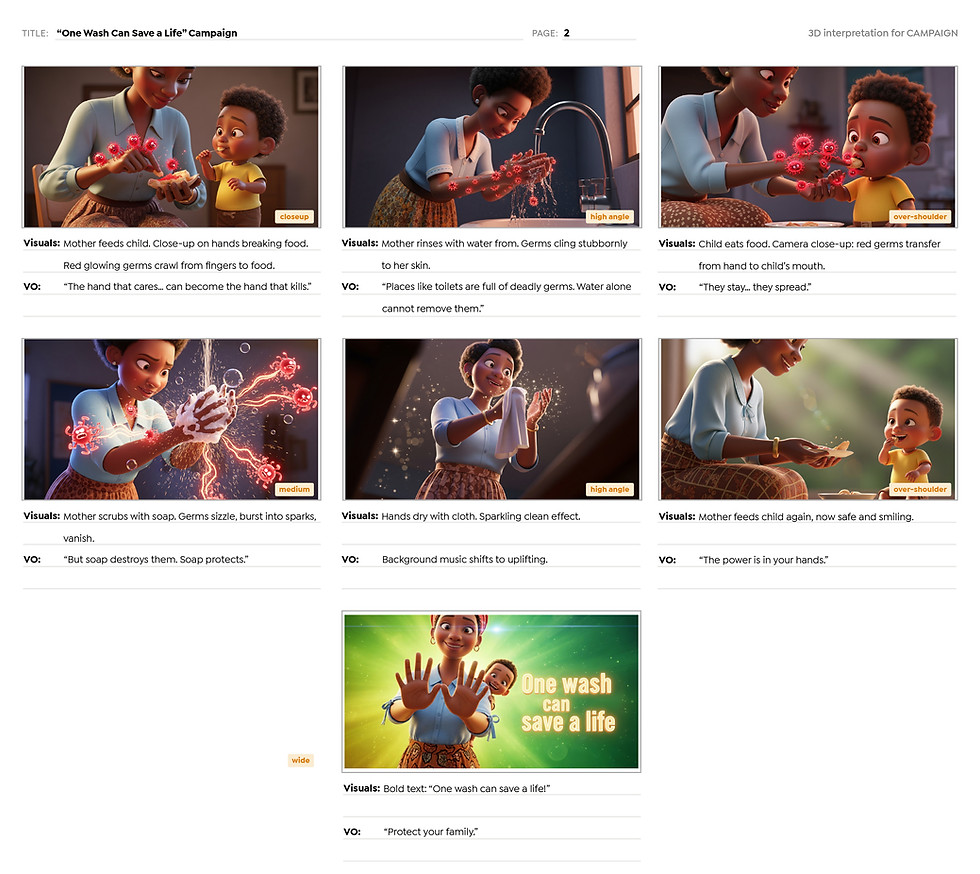
VO: “Places like toilets are full of deadly germs. Water alone cannot remove them.”
(Sound: pouring water, slow dripping echo. Visual: germs clinging stubbornly to skin.)
[Turning Point – Empowerment through Soap]
VO: “But soap destroys them. Soap protects.”
(Sound: sizzling as germs dissolve, uplifting music begins to build.)
[Resolution – Safety and Renewal]
VO: “One wash can save a life.”
(Sound: sparkling water, bright instrumental rise.)
[Closing – Call to Action]
VO: “Protect your family. One Wash Can Save a Life.”
(Sound: gentle music fade-out, campaign tagline appears: “#OneWashCanSaveaLife”)
The Script
Storyboard
The storyboard served as the visual and structural blueprint for translating the campaign’s script into a cohesive cinematic 3D narrative. Each frame was deliberately designed to correspond with the emotional and thematic stages of the campaign; Fear, Revelation, Empowerment, and Resolution, ensuring a smooth flow between message delivery and visual storytelling.
Hand-drawn panels first outlined each key moment: the mother feeding her child, germs crawling from hands, rinsing at the jerrycan, the dramatic soap intervention, and finally the clean, hopeful resolution. These 2D sketches became the foundation for 3D modelling and animation using Whisk, where volumetric lighting, camera depth, and atmospheric effects brought realism and emotional depth to the imagery.

The storyboard visually mapped every sequence, defining camera angles, lighting moods, character positions, and symbolic color schemes. Red tones were used to signify danger and contamination; golden and green hues represented safety and cleanliness. These visual contrasts guided the emotional rhythm of the campaign. The mother and child were depicted as African characters with medium-dark skin tones, natural hair, and culturally familiar attire, reinforcing authenticity and cultural resonance.

Images and Visual
Symbolism
The visual language of the campaign was carefully constructed to evoke both fear and hope, ensuring symbolic clarity and cultural familiarity;

A
Red Glowing Germs
Represent invisible danger; use of red signals contamination and urgency, consistent with visual semiotics of threat.
B
Soap as Light (Hope Soap)
Embodies cleansing, safety, and empowerment, transforming fear into positive action.
C
Dark-to-Light Transitions
Symbolize transformation and renewal, aligning with the emotional journey from danger to protection.
D
African Mother and Child
Create cultural familiarity and empathy; position the act of handwashing within real domestic contexts.

E
Infrastructure and Local Environment
Reflect Ugandan household identity, reinforcing realism and accessibility.
E
Floating Bubbles and Sparkles
Convey purity, victory, and joy, making cleanliness visually satisfying and emotionally rewarding.
Character Design Catalog


Treatment
The storyboard translated into 3 Dimensional scenes
Reflection on the Creative Process
Throughout production, the creative process balanced ethical considerations, technological experimentation, and cultural sensitivity. The decision to use stylized 3D characters rather than live actors addressed consent and identity exposure issues while maintaining emotional engagement through expressive animation.
Tools such as Whisk, VEO 3, and Nano Banana (JSON prompts) enabled precision, character continuity, and cinematic realism, bridging artistry with data-driven control. This integration of design and technology transformed 3D animation into not just a visual choice but a methodological tool for communication design.
Intended Impact and Significance
The campaign’s rationale extends beyond aesthetics, it aligns with Uganda’s WASH objectives and SDG 6 (Clean Water and Sanitation) by offering an interactive, scalable, and culturally resonant approach to hygiene promotion.
By combining fear-to-empowerment storytelling, visual semiotics, and 3D immersion, the campaign sought to:
-
Strengthen behavioural adherence through emotional engagement.
-
Foster social learning and community dialogue.
-
Provide a replicable communication model adaptable across regions and digital platforms.
Ultimately, “One Wash Can Save a Life” transforms hygiene education into a shared story of protection and hope, proving that 3D animation can serve as both a pedagogical and public health innovation.

Summary
The development of the campaign from concept to final composited video illustrates how the original fear-based strategy could be preserved while reconfigured into a modern 3D animation format. Each stage; from scripting to 3D modelling, audio generation, animation, and editing, ensured that the campaign’s emotional power was not lost but amplified through visual clarity, cinematic effects, and narrative immersion. The findings demonstrate that the acquired design elements; characters, colours, tone, and message, could be expanded in 3D to produce a campaign that is both faithful to its original strategy and adapted to new digital platforms.